
Self-Employed? Three Bookkeeping Habits That Save Your Sanity (and Your Taxes)
May 2026 | Newsletter #3
Self-Employed? Three Habits That Save Your Sanity (and Your Taxes)
The best bookkeeping tips for self-employed professionals aren’t complicated — but they do require consistency. When you’re running a one-person show, you’re the marketing team, the customer service desk, the delivery person, and somewhere in all of that, you’re also supposed to be your own bookkeeper.
It’s no wonder receipts pile up, tax season feels like a panic attack, and you have no real sense of what your business actually earned last month. The good news? You don’t have to overhaul your life. A few simple habits, repeated every month, will make your numbers feel like a friend instead of a threat.
Bookkeeping That Works When You’re a One-Person Show
Bookkeeping for self-employed pros isn’t about fancy software or color-coded spreadsheets. It’s about giving yourself a clear, current picture of where your money is coming from, where it’s going, and how much of it actually belongs to you after taxes.
Unlike salaried employees, self-employed professionals are responsible for their own quarterly estimated tax payments, expense documentation, and financial record-keeping. Without consistent bookkeeping habits, it’s easy to overspend, underpay taxes, and end up scrambling every April.
If you only build three habits this year, make them these:
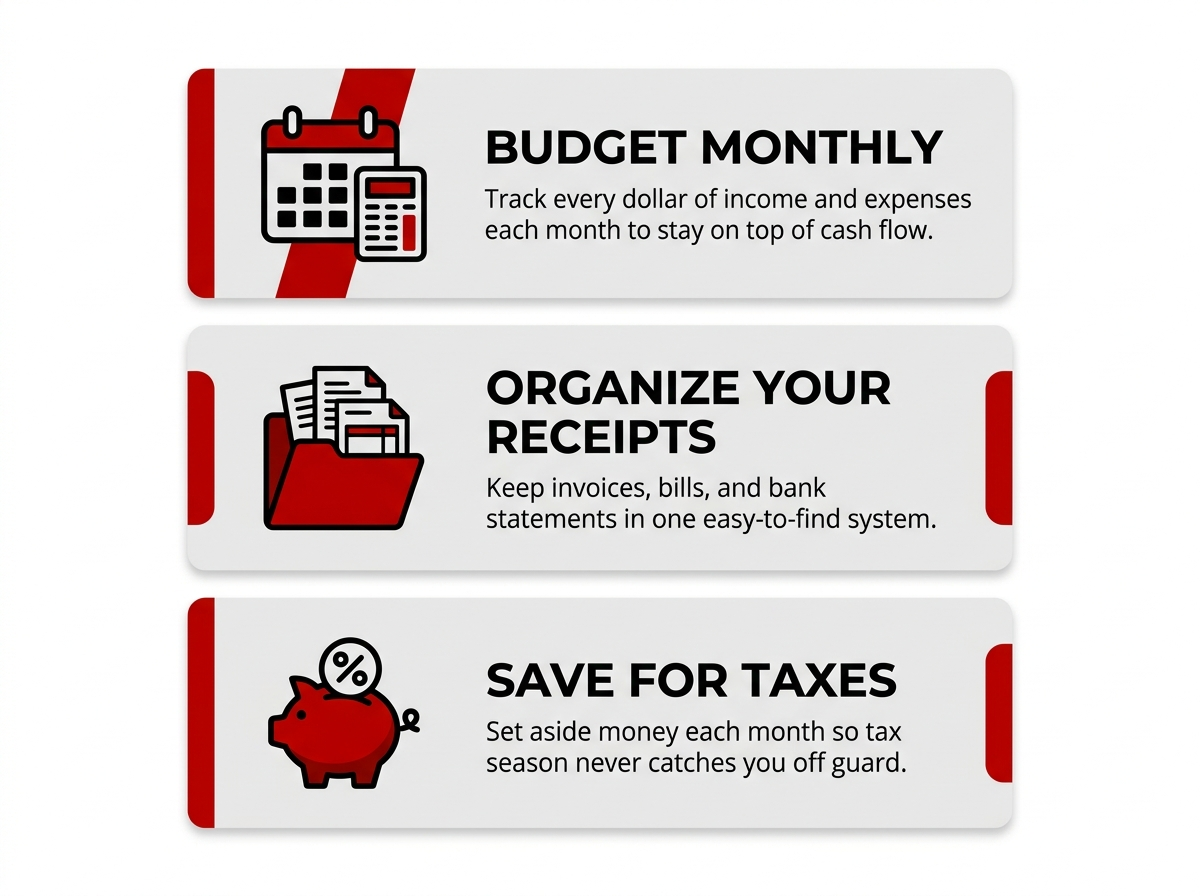
1. Build a Monthly Budget to Track Income and Expenses
One of the most powerful bookkeeping tips for self-employed professionals is deceptively simple: create a monthly budget. Not a complicated spreadsheet — just a clear picture of what’s coming in and what’s going out.
A monthly budget lets you:
- See your cash flow at a glance before you make spending decisions
- Spot months where income dips so you can plan ahead
- Catch recurring expenses that no longer serve your business
- Know exactly how much you can reinvest versus what you need to hold
Even a simple two-column spreadsheet — income on one side, expenses on the other — reviewed once a month will transform your financial awareness. Block 45 minutes on your calendar at the end of each month. Once it’s a habit, it rarely takes that long.
If you want to go a step further, tools like QuickBooks Self-Employed or Wave (free) can automate a lot of the categorization so your monthly review becomes a 15-minute scan instead of a manual entry session.
2. Create a System for Organizing Receipts, Invoices, and Bank Statements
Missing documentation is one of the most expensive mistakes self-employed professionals make. A receipt you can’t find is a deduction you can’t take. An invoice without a payment date creates cash flow confusion. A bank statement you never reviewed hides errors that compound over time.
You don’t need a filing cabinet. A simple digital system works:
- Digital receipts: Use an app like Dext, Hubdoc, or even a dedicated email folder to capture receipts the moment they happen
- Invoices: Keep a sent-invoice log so you always know who owes you and when payment is due
- Bank and credit card statements: Download and review monthly — look for unfamiliar charges and categorize transactions while they’re fresh
- Tax documents: Keep a dedicated folder (Google Drive works perfectly) for 1099s, contractor agreements, and any business-related legal documents
Consistency beats perfection here. A simple system you actually use is worth far more than an elaborate one that collects dust. The goal is that when your bookkeeper or tax preparer asks for something, you can find it in under two minutes.
Need help setting up a system that works for your specific business? Yield Bookkeeping offers a free consultation to walk you through exactly what you need — and nothing you don’t.
3. Set Aside Money for Taxes Every Single Month
This is the bookkeeping habit that saves most self-employed people from tax-season panic. As a self-employed professional, no employer is withholding taxes on your behalf — which means every dollar you earn is a pre-tax dollar, and the IRS will eventually want their share.
A reliable rule of thumb: set aside 25–30% of every payment you receive into a separate savings account the moment it arrives. Don’t wait. Don’t spend first and save later. Move it immediately and treat it as untouchable.
This does two things: it ensures you’re never caught short at tax time, and it prevents you from accidentally spending money that was never truly yours to spend. If your income is variable — as it often is for self-employed professionals — this habit is even more critical because your quarterly estimated tax payments will fluctuate with your earnings.
“You didn’t go into business to do bookkeeping. You went into business so bookkeeping could tell you the truth about your business.”
Bonus: Establish a Filing System for Important Documents
Beyond the monthly habits above, it pays to have a long-term home for your most important business documents — contracts, tax filings, business licenses, insurance policies, and any legal agreements. Whether it’s a labeled folder in Google Drive or a physical binder, knowing exactly where these documents live saves you time and stress whenever you need them.
A good filing structure for self-employed professionals looks like this:
- Taxes — quarterly estimates, annual returns, 1099s received
- Clients — contracts, invoices, payment records by client
- Expenses — receipts, subscriptions, business purchases
- Legal — business registration, insurance, any agreements
- Banking — monthly statements, loan documents
When Bookkeeping Becomes Too Much to Handle Alone
These bookkeeping tips for self-employed professionals will take you far — but there comes a point where the time you spend on bookkeeping is worth more than the cost of outsourcing it. When bookkeeping starts eating into billable hours, it’s time to bring in a professional.
A bookkeeper doesn’t just handle data entry. At Yield Bookkeeping, we help self-employed professionals and small business owners:
- Set up a bookkeeping system tailored to your specific business model
- Stay compliant with tax obligations throughout the year — not just in April
- Produce clean financial reports that help you make smarter decisions
- Catch errors and discrepancies before they become costly problems
- Free up hours every month to focus on the work that actually pays the bills
We serve self-employed professionals and small businesses nationwide, working remotely with clients across every industry. Our free consultation is a no-pressure conversation about where your books stand and what it would take to clean them up.
Start With One Habit This Month
You don’t have to build all three systems at once. Pick the one that feels most urgent — probably the tax savings account if you haven’t started one yet — and make it automatic. Once that’s on autopilot, add the next one. Small, consistent actions compound into financial control you can actually feel.
Your business deserves accurate books. And so do you.